What's Actually Under a Paver Patio That Lasts
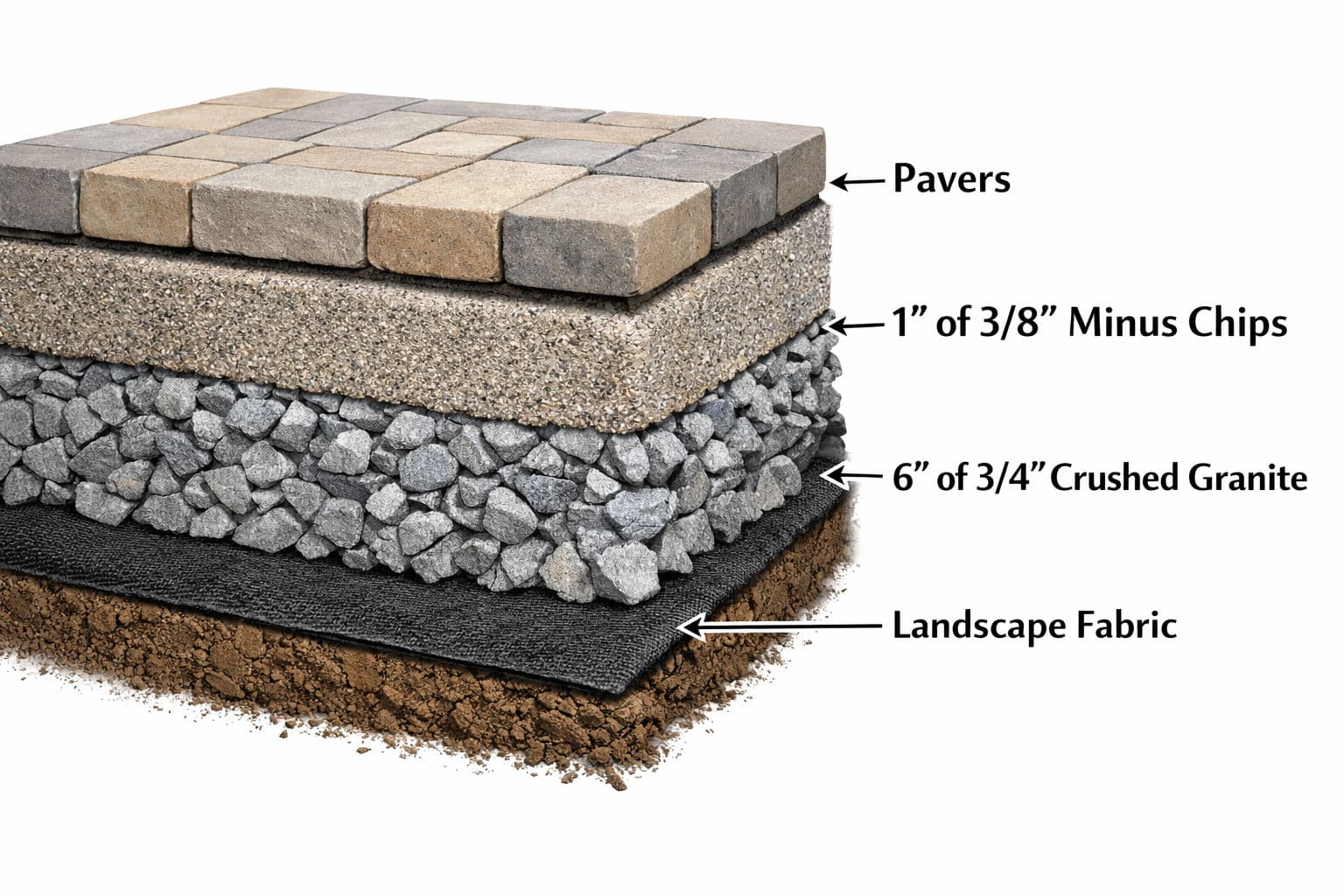
Most people focus on what a paver patio looks like. Fair enough - the surface is what you see every day. But what you can't see is what actually determines whether your patio holds up for decades or starts shifting and sinking within a few years.
Here's how we build it. It starts at the bottom - landscape fabric laid directly on the graded soil to keep weeds from pushing through and to separate the soil from the stone above it. On top of that goes 6 inches of 3/4" crushed granite. That's your structural base. It compacts tight, drains water fast, and doesn't move. Minnesota freeze-thaw cycles are brutal on hardscapes, and this layer is what fights back.
Then comes 1 inch of 3/8" minus chips - a finer aggregate that gives us a smooth, level bedding surface to set the pavers into. That precision matters. It's what keeps the finished surface flat and locked in position. Finally, the pavers go on top and get set into that layer, creating a surface that flexes slightly with the ground instead of cracking like a rigid concrete slab would.
That last part is worth repeating. Concrete is one solid piece - when the ground moves, it cracks. Pavers are individual units sitting on a flexible, well-drained base. When everything underneath is done right, there's nowhere for water to pool and no reason for the surface to heave or shift. That's the difference between a patch job every few years and a patio that just keeps looking good.
We use this same layered system on every patio and hardscape installation we do. It's not the flashiest part of the job, but it's the part that actually matters.